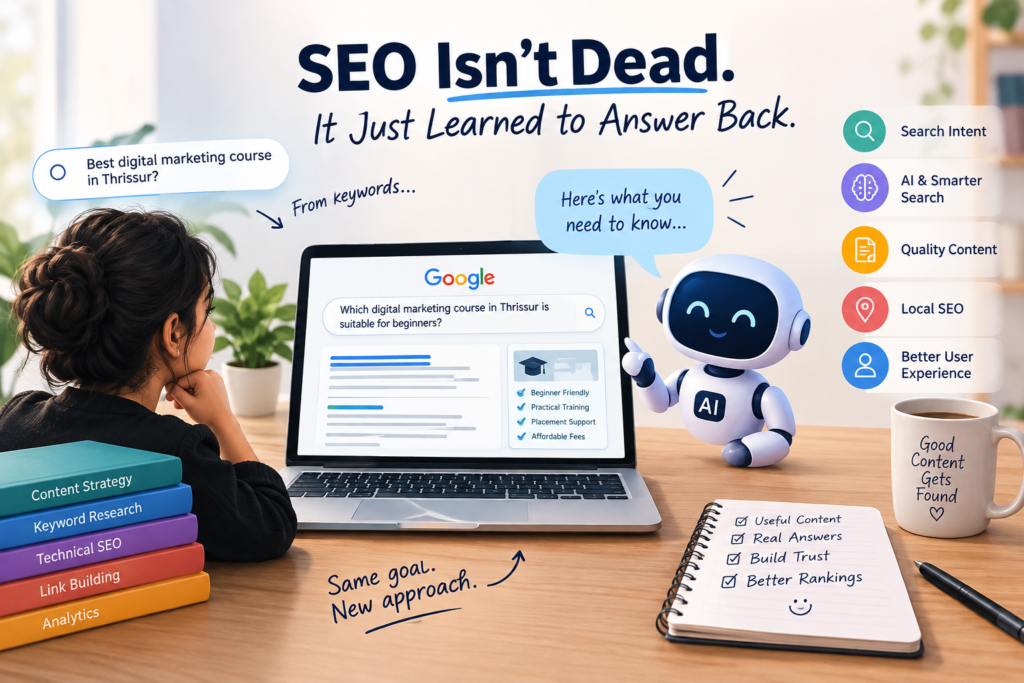
For years, people have predicted the death of SEO. Every time Google introduces a major algorithm update, social media trends change, or a new AI tool becomes popular, the same question comes up: Is SEO dead?
The simple answer is no.
SEO is not dead. It is changing.
Search Engine Optimization has evolved from simply adding keywords to a webpage into a much broader strategy focused on understanding users, answering their questions, building trust, and creating genuinely useful content. Today, search engines are becoming smarter, and users are becoming more demanding. SEO has learned to “answer back” by becoming more conversational, helpful, and user-focused.
The Old SEO vs. The New SEO
Traditional SEO was heavily focused on keywords, backlinks, meta descriptions, and ranking pages on search engines. While these elements are still important, they are no longer enough on their own.
In the past, a website might target a keyword such as “best digital marketing course in Thrissur” and repeatedly use that exact phrase throughout a page. Today, search engines can understand context, search intent, related topics, and the overall quality of the content.
Modern SEO asks a different question:
“What does the user actually want to know?”
Instead of writing content only for search engines, marketers now need to create content for real people. The goal is to provide an answer that is useful, clear, accurate, and easy to understand.
Search Is Becoming More Conversational
One of the biggest changes in SEO is the way people search.
Users are no longer limited to short keyword phrases. They increasingly ask complete questions, especially when using voice search and AI-powered search tools.
For example, instead of searching:
“digital marketing course Thrissur”
a user might search:
“Which digital marketing course in Thrissur is suitable for beginners?”
This changes how content should be created.
Businesses need to understand the questions their audience is asking and provide direct answers. Blog posts, FAQs, guides, comparison pages, and informative landing pages can all help a website respond to these conversational searches.
In other words, SEO is becoming less about matching words and more about matching intent.
AI Is Changing Search, Not Ending SEO
Artificial intelligence has transformed the digital landscape. AI-powered tools can generate answers, summarize information, and help users find what they need quickly.
This has made some marketers believe that people will stop visiting websites altogether.
But AI has not eliminated the need for quality content. Instead, it has increased the importance of creating content that demonstrates knowledge, credibility, and real value.
AI can provide quick answers, but users may still need original sources, detailed explanations, products, services, examples, expert opinions, and trustworthy websites.
This means businesses should not simply create large amounts of AI-generated content. They should focus on useful, original, human-centered content supported by real experience and reliable information.
The future of SEO is not humans versus AI. It is about learning how to use technology while maintaining quality and authenticity.
User Intent Is the New Keyword Strategy
Keywords still matter, but understanding search intent matters even more.
Search intent refers to the reason behind a user’s search. A person searching for “what is SEO” is probably looking for information. Someone searching for “SEO agency near me” may be looking for a service. Another person searching for “SEO tools” may be comparing available solutions.
These users have different needs.
Successful SEO content should match those needs.
There are four common types of search intent:
- Informational: The user wants to learn something.
- Navigational: The user wants to find a particular website or page.
- Commercial: The user is researching products or services before making a decision.
- Transactional: The user is ready to take an action, such as buying or signing up.
Understanding intent allows marketers to create content that answers the right question at the right stage of the customer journey.
Quality Matters More Than Quantity
The internet is full of content. Publishing another generic article is not enough to stand out.
Modern SEO rewards a stronger approach: create content that deserves attention.
A useful article should provide clear information, practical examples, original insights, and answers to common questions. It should also be easy to read on both desktop and mobile devices.
For example, a digital marketing website could publish a detailed guide explaining how a small local business can use SEO to attract customers. Instead of simply defining SEO, the article could include keyword research tips, local SEO strategies, examples, common mistakes, and measurable goals.
That type of content provides real value.
The objective is no longer simply to produce more content.
It is to produce better content.
Local SEO Is Still Powerful
For local businesses, SEO remains an important way to connect with nearby customers.
Imagine someone searching for a restaurant, dentist, salon, photographer, or digital marketing professional in their city. They want relevant results from businesses that can actually serve them.
Local SEO helps businesses become more visible for these searches.
Optimizing business information, creating location-specific content, collecting genuine customer reviews, maintaining consistent business details, and building local relevance can all contribute to stronger local visibility.
For small businesses, this means SEO is not only about competing globally. It can be about becoming more visible to the right people in the right location.
SEO Now Requires Multiple Skills
SEO is no longer the responsibility of just one technical specialist.
Modern SEO combines several areas of digital marketing, including:
- Content creation
- Keyword research
- Technical optimization
- User experience
- Website performance
- Local SEO
- Analytics
- Link building
- Social media awareness
- AI and search technologies
A successful SEO professional needs to understand both technology and people.
They need to know how search engines work, but they also need to understand what audiences want, what problems they have, and what makes them trust a business.
The Future of SEO
SEO will continue to change.
Search engines will become more intelligent. AI-powered search experiences will continue to develop. Users will search through different platforms and devices. Visual search, voice search, conversational queries, and personalized experiences may become increasingly important.
But one thing is unlikely to change:
People will always need useful information.
As long as people have questions, businesses and websites will have opportunities to provide answers.
The SEO professionals who adapt to these changes will focus less on manipulating rankings and more on creating genuine value.
Final Thoughts
So, is SEO dead?
Not at all.
SEO has simply grown up.
It has moved beyond keyword stuffing and basic ranking tricks. It now involves understanding search intent, creating valuable content, improving user experience, building trust, and adapting to AI-powered search.
The phrase “SEO Isn’t Dead. It Just Learned to Answer Back.” captures this transformation perfectly.
SEO is no longer just about asking search engines to notice your website.
It is about giving search engines—and more importantly, your audience—a reason to notice you.
The future belongs to businesses that can answer questions clearly, solve problems effectively, and create experiences people actually value.
SEO isn’t disappearing.
It is evolving, becoming smarter, more conversational, and more human.